Messages from Heaven - AI Driven Interactive Simulation Project
DEVELOPMENT TOOLS: Unity, Photoshop, Adobe Premiere

"The tone and inner expressions you choose are shaping a world."
Core Positioning & Narrative Framework
Game World
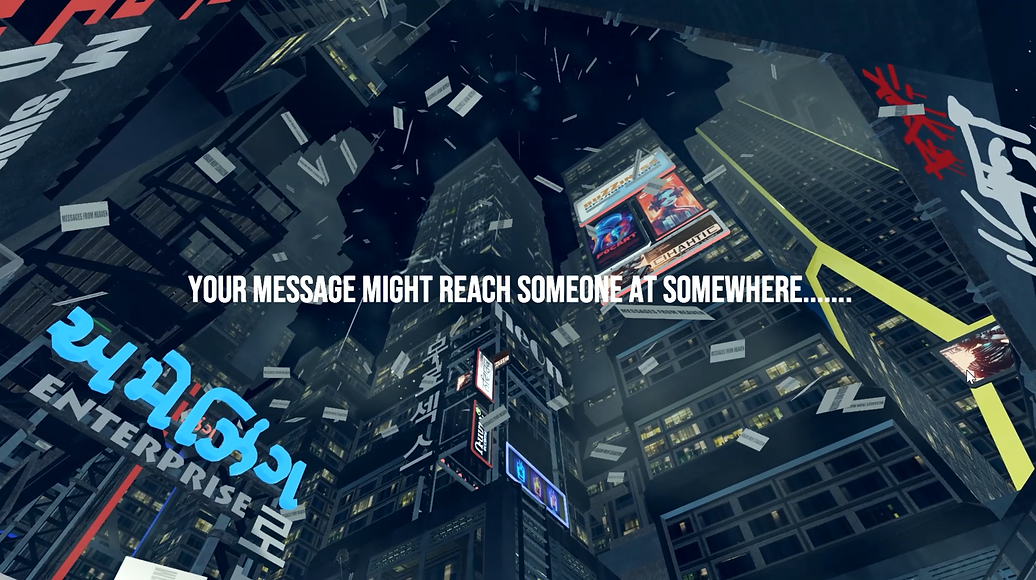
A fictional Christmas Eve in Manhattan, New York. Empty streets blanketed by endlessly falling "Messages from Heaven" envelopes.
Player Character
A first-person wanderer, the "Listener/Speaker"—neither a hero nor an omniscient observer.
Core Rules
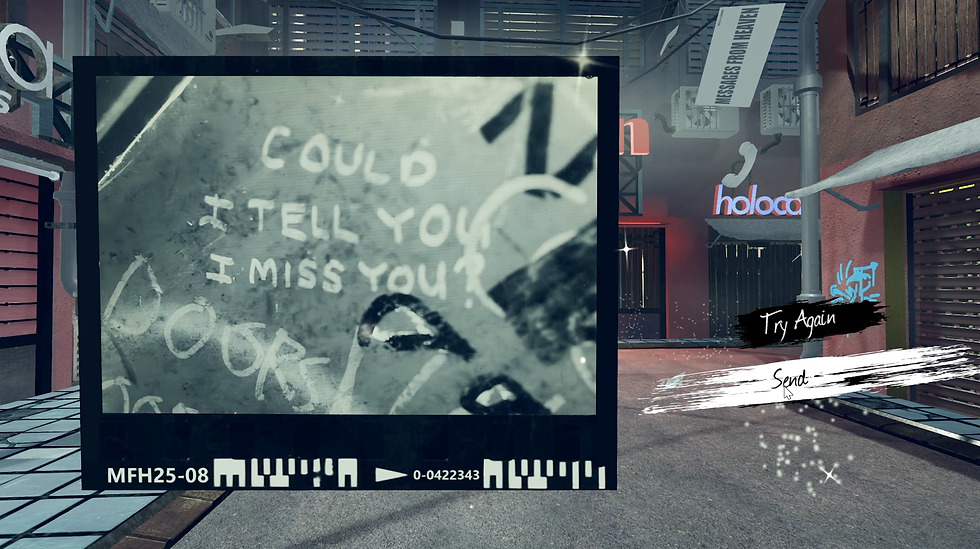
Each letter unfolds into a postcard bearing authentic handwritten texts/graffiti. Player responses are analyzed and categorized into E (Empathy) / A (Anger) / N (Neglect), with choices accumulating to shape the city's global emotional state.
Unique Points
Language as Mechanic: Natural language inputs feed directly into the E/A/N (Empathy/Aggression/Neglect) emotional model, driving the environment and outcomes rather than relying on traditional numerical progression. Social Mirror Experiment: All messages are stored in a shared database, later retrieved by other players, forming an observable "City Mood Archive"—a collective emotional footprint.
Player Core Experience
Goals Experience "How different words shapes a world" in 2–3 minutes: Observe how your attitude toward a stranger’s words is translated into the “Emotional Climate” of a city, continuously reshaping the Manhattan on a snow night.
Credits
Game Design: Zikun Chen
Narrative Design: Zikun Chen
Interaction & UI Design : Zikun Chen
Visual Design & Environment Editing: Zikun Chen
Programming & Technical Development: Yuzhou Chen
Production Management : Jie Zheng


AI Emotion System & Social Simulation
City Feedback & 3 Endings:
High E (Empathy): Streetlights glow warmer, Floating colored particles increase, distant choral voices rises.
High A (Anger): Wind speed intensifies, Neon signs flicker violently, Metallic clangs and noise pollution dominate
High N (Neglect): Streets appear emptier, Snowfall becomes denser, Music fades out, leaving only wind and footsteps
E-A-N Emotion System:
E (Empathy): Understanding and caring for others
A (Anger): Confrontation and accusation
N (Neglect): Avoidance and self-focused talk
System calculates global E/A/N averages to determine city states: Warm Snow City (E-dominant), Night of Raging Storms (A-dominant), Silent Blizzard (N-dominant) or Community of Contradictions (balanced extremes)
AI Counterquestions & Ethical Profile
After each emotional calculation, the AI generates a brief "provocative question/commentary", which players may optionally respond to.
The system builds an "Ethical Profile" for each player, tracking their long-term E/A/N trends. Based on this data, the AI adapts its questioning tone and content in subsequent sessions, ensuring feedback maintains: Continuity (referencing past behavior patterns), Reflexivity (challenging emotional biases).


Gameplay & Interaction Flow
Core Loop : Pick Up → Read → Choose Response Path → Input Text → AI Analysis & New Card Generation → City Feedback & Redistribution
1. Pick Up : First-person walking, acts as a "dreamcatcher" to click and capture falling envelopes to obtaining postcards.
2. Read : Postcards unfold at the center of the screen, displaying handwritten messages.
3.Respond: Three selections - Continue the original text & Write a reflection & Compose a new message.
4.Send: Player input is sent to the backend, where the AI lightly refines the text and generates a new postcard.
5.feedback: The system calculates the E/A/N (Empathy/Anger/Neglect) vector of the response. New cards are archived in the database and may later be picked up by other players, creating a content feedback loop.

Art Design
Interaction follows the Rule:
"One letter = One read/write cycle = A change of the world." The dreamcatcher cursor reinforces the metaphor of "actively capturing others' voices.
Visual Style
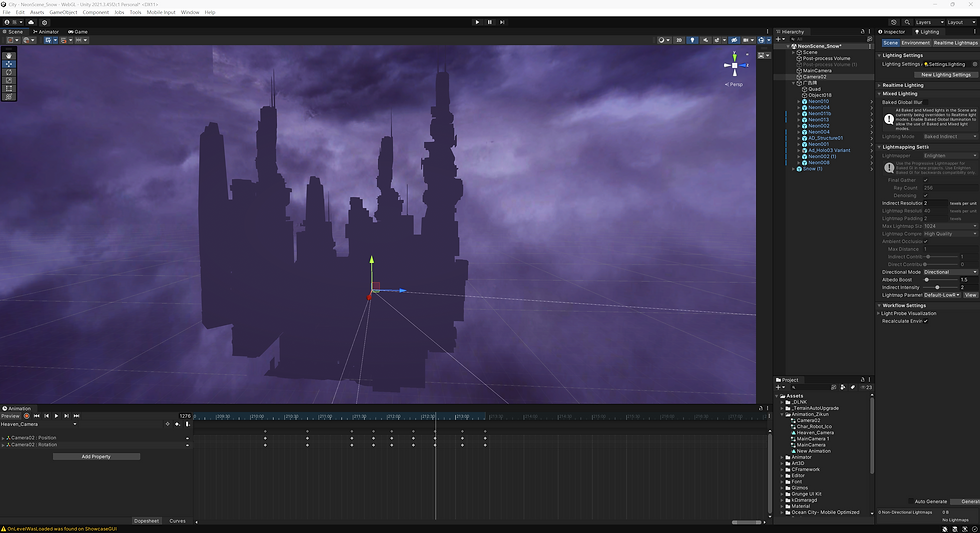
A single block of night time Manhattan, blending: High-contrast neon lights, Volumetric fog, Snow particle effects. This creates a dual-layered space—"realistic cityscape × abstract emotional overlay".
UI/UX
"The city is the interface"—input prompts, system messages, and emotional states are primarily displayed through wall graffiti, neon signs, and aerial projections, minimizing traditional dialog boxes.



Envelopes & Postcards
Vintage paper textures, Handwritten fonts, Uniform serial numbering. Function as both emotional vessels and data units.


Technical System
GPT emotion Analyze System
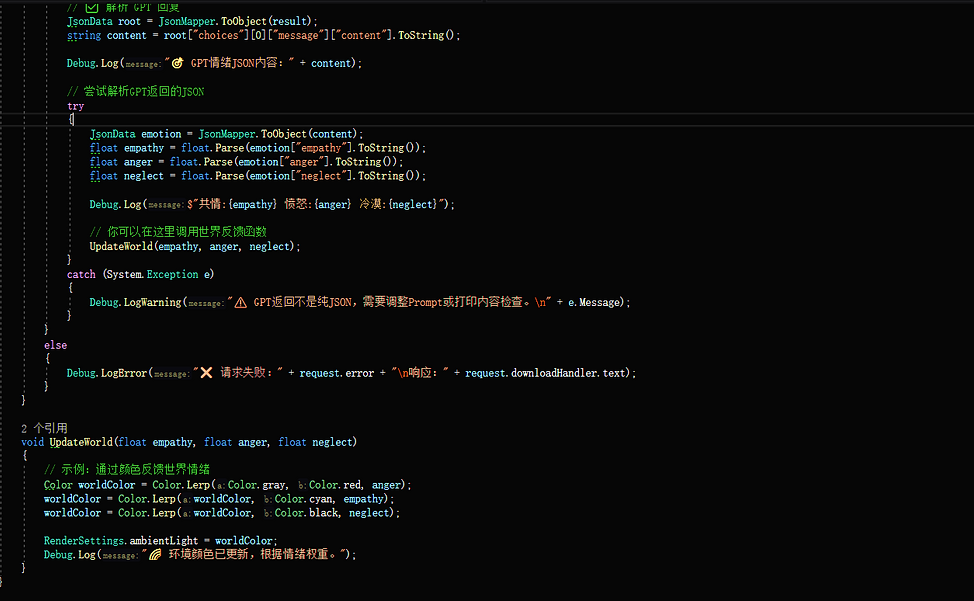
This system communicates with the OpenAI API to analyze the emotional relationship between the player's input and the postcard content. It outputs three categories of emotions—empathy, anger, and neglect—along with their numerical weights.
Core functions:
-
Calls the Chat Completions API and sends a structured prompt.
-
Parses the JSON response and extracts dominant_emotion, weights, and explanation.
-
Dynamically updates UI text with Animatext animations. Invokes UpdateWorld() to adjust the ambient light color based on emotional weights.
-
Propagates emotion status to downstream systems such as post-processing and global feedback.

Script of GPT Emotion Analyze System
Emotional Scene Transition
After receiving the emotional classification from the sentiment analyzer, the system triggers global visual feedback, including:
-
Three independent post-processing Volume Profiles (Empathy, Anger, Neglect)
-
Corresponding Skybox for each emotional state
-
Three MaskEffect styles (Fade / Dissolve / Sharp)
For each emotional state, only the corresponding Effects[i] is activated while the others remain disabled, improving WebGL performance and ensuring visual consistency.

(1) Anger
-
Tone Mapping: ACES
-
Temperature +51, Tint -18
-
Saturation -11, Contrast 30
-
HDR red filter
-
Trackballs: red-leaning high-contrast curve

(2) Neglect
-
Tone Mapping: Neutral
-
Temperature -55, Tint +28
-
Saturation 3, Contrast 50
-
Channel Mixer: Green 139
-
HDR green filter
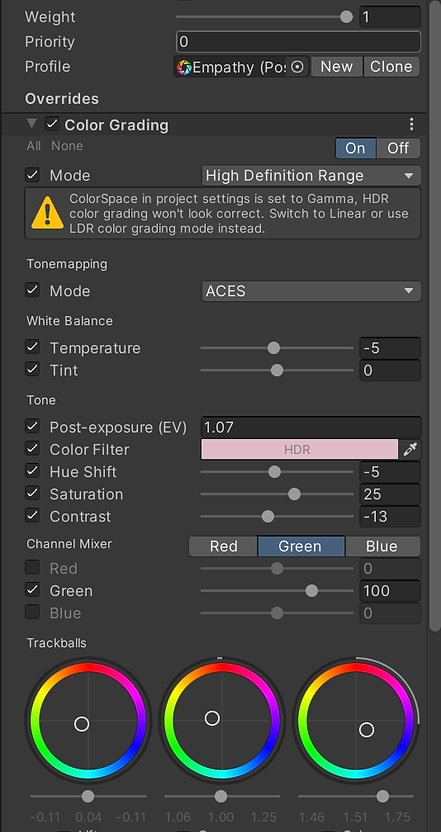
(3) Empathy
-
Tone Mapping: ACES
-
Post-Exposure +1.07 EV
-
Saturation 25, Contrast -13
-
HDR pink filter
-
Trackballs: warm, soft glow
Data Loop
All new postcards and their metadata are written into the database after each round of interction, from which the system samples and redistributes them according to time and mood tags, forming a closed loop of “player input → data storage → content feedback.”
Development Reflections & Key Iterations
Creative Motivation
Building upon my father’s 1993 eponymous behavioral data artwork—which established an anonymous, open-ended social expression network—this project merges that hidden "inner voice" internet with contemporary AI technology. It serves as a small-scale social experiment exploring the relationship between individual emotions and collective resonance, transforming the entire city into a low-barrier yet profoundly open anonymous human-AI interaction network. By structuring expression as data and feeding it back into the environment, the project prompts players to recognize and reflect on how their language and emotions shape—and are shaped by—the world around them.


Key Iterations
Emotion Model: Evolved from a binary positive/negative scoring system to the triaxial E/A/N framework, mapping attitudes toward others/world/self—enabling quantifiable choices and distinct outcomes.
AI's Role: Upgraded from a "scoring tool" to a "World Director + Socratic Questioner." It dynamically controls lighting, weather, and eventsm whcih provides continuous feedback through counterquestions and ethical profiles, reflecting players’ long-term behavioral patterns.
Design Insights: Treating games as "rule-based narrative systems." Designers avoid fixed plots, instead crafting mechanisms for players and AI to co-author an emergent emotional history of the city. The city becomes a living archive, where every interaction subtly rewrites its collective memory.

For more Project

AGEPASS
A living system where “screening equals computation.” The audience are co-authors.

The Killer
“The Killer”is a full-motion video (FMV) interactive narrative PC game demo.

Mind Heist: LIANG
An ongoing narrative-driven 3D action ARPG prototype, built with Unreal Engine 5.